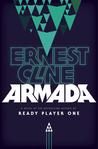
 Armada by Ernest Cline
My rating: 3 of 5 stars
Of course when I found out that Ernest Cline was writing another book, I had to read it. Ready Player One was one of my most favorite reads in the past few years. I certainly hate to compare one book with another, but I can't completely separate the two book, partially because the author refers to let me, and that isn't a good thing.
The book is missing some crucial components to make it great. The first is voice. This book seemed very lacking when it came to well-composed sentences and characters with unique voices. The narrator, Zack Lightman, didn't really have a unique or believable voice to me, which hindered my caring about what happened to him as a character. The story was still entertaining enough to push through, but in this genre, I feel like the reading should be effortless, and it wasn't. It wasn't due to intentional syntactical difficulties (or any syntactical difficulties for that matter), vocabulary, or complex themes, which I feel like are valid reasons for readers to slow down in their reading. It just simply was due to an indifference on my own part.
Also, given the open-ended nature of the book, it seems as if a sequel could be in the works, which might quell some (but not all) of the complaints I am about to mention. My second real complaint is that there was way too much superfluous information in the book. The extra stuff served no purpose to me: it didn't make the work more real; it didn't add to my understanding of the characters in any real way; and it wasn't addressed later in the book (though it could be in a sequel). I also found that the relationship between Zack and Lex. It was completely unnecessary unless there are sequels. It just seems like he wanted an ill-conceived and not well-developed, forced love story in the book. There could have been much more actually story instead of the pages wasted on Lex.
I was much more intrigued by (view spoiler)
Also, Ernest Cline's knack for constantly referencing the 80s, video games, and cult classic movies didn't stop with Ready Player One, and while I found some of the references more than welcome, many of them felt forced and didn't really add much uniqueness to the characters or story.
The conspiracy theories stemming from Zack's father's journal I found very intriguing. I also liked the mythos that was built with these disappearing arcade games. Next time I play a space battle video game, I will think of the conspiracies mentioned in this book.
Overall, it fell flat, and my own nerdiness it what made me like it. I am actually hoping for a sequel. I think that a lot of the unnecessary elements of this book could be made more complete by a (hopefully better written) sequel.
View all my reviews

No comments:
Post a Comment