Monday, January 12, 2015

Review of Turn Around Bright Eyes

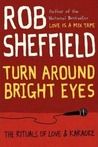
Turn Around Bright Eyes: The Rituals of Love & KaraokeTurn Around Bright Eyes: The Rituals of Love & Karaoke by Rob Sheffield
My rating: 4 of 5 stars

I have been keeping up with Rob Sheffield since reading his debut memoir, Love is a Mix Tape. He certainly got me hooked. Years before, I had encountered the tall, lanky, geeky Rob on some VH1 countdown, which is like crack to me, especially when the countdown incorporates a lot of music pre-1996 or so. Before 1996, I have retained an inventory of pop and rock popular music knowledge. Rob certainly makes no quips about loving pop music, but he also loves Pavement, so I certainly can at least connect with him there. The masters in English certainly gives us common ground as well. Rob also seems to tie what he listens to to his life experiences at the time that he listens. I relate to his "autobiographic" catalog of music (High Fidelity reference) in much the same way. On first seeing him, he had a Rolling Stone under his name, which didn't necessarily bolster my opinion, but his humor in talking about music just came across as intelligent and bantery in the kind of way that reflected someone who actually knew what he was talking about.

His sophomore release Talking to Girls About Duran Duran contained the same humor and anecdotal storytelling as his first book, but it just lacked "something." Maybe I just didn't connect with the common thread as much.

That was not the case with his third attempt. This book served as a kind of sequel to his first book. He recounts his move to New York to get away from his old life in Charlottesville, life tainted by the death of his wife in his late twenties. Ultimately, the glue that holds everything together, karoake, became the medium in which he told his grief cycle, his 9/11 experience, falling in love with the City, and ultimately, falling in love with the second love of his life (no, not karaoke) his wife, Allie.

Rob's humor and sense of self-deprecation is endearing, a difficult task to accomplish without seeming like you are just being untruthful or the other extreme: complaining about life. What happens in Rob's case is he achieves growth, discovering universal truths through whatever is his current obsession.

The book even made me want to try karaoke-- a vastly extroverted task for an introvert like me. Also an odd occurrence for my inner music snob. While I would certainly have to comb through the catalog of crap, in looking at common karaoke lists, I do believe that I could find a whole lot that I would enjoy to sing, mostly 80s one hit wonders, guilty pleasures, and occasional jewels that one has to look deeply for (Ben Folds! Who knew?). I guess my message here would be, look for me at a karaoke night near you... okay, maybe not, but I may be experiencing the closest thing on my Wii console soon enough. Who knows, maybe we will even have people over and make it a collective experience.

This book perfectly closes the hole left open in my heart from his debut. I would love to see The Rob Sheffield Story: Highway to Hell and Back at my local theater, or at least as a Lifetime movie of the week (Rob would approve).

View all my reviews

Friday, January 2, 2015

Review of A Separate Peace

A Separate PeaceA Separate Peace by John Knowles
My rating: 4 of 5 stars

I now understand why this book is often considered a modern masterpiece. Knowles is very economical with his words. He does just what he has to in order to accomplish his purpose. He left me thinking of not only themes about growing up, but the truth about perception vs. reality and of course themes about war. On considering the message behind growing up, the message that I receive is that none of us truly ever grows up. Growing up seems unattainable, as it means something different for each new generation. Every image that Knowles paints, the descriptions that he gives, and the philosophy that Gene spouts (not that Gene recognizes the weight of his meandering thoughts) are integral to meaning. The author's prose is truly masterful.

I had and still have many doubts regarding Gene. I find him vastly unreliable. The unreliability is compounded by the separation in time that Knowles sets up with the framed narration from the beginning (though the frame is never really closed). Gene's sees the world through rose-colored glasses in the beginning of his recollections, but as Phineas, Gene's "best friend" and role model. I get the impression that Gene builds up the character to legendary, godlike status (view spoiler)

The setting, a boarding school called the Devon school, is perfectly imagined. While I do at times have trouble relating to boys at a boarding school in the early 1940s, the message of the book is universal. I noticed that the character's attitude toward authority, establishment, and doubting of the truth is one that teens, especially fictionalized teens still experience.

Knowles is masterful, even in the selection of his characters' names. Gene: a representative for humanity (so universal, it is programmed in our DNA), Phineas (Finny) swimming through life without a worry in the world, Brinker: always on the edge of starting something, committing to life, but never quite making it.

A classic, but page-turning read.

View all my reviews

Tuesday, December 30, 2014

Review of Eleanor & Park

Eleanor & ParkEleanor & Park by Rainbow Rowell
My rating: 3 of 5 stars

I really wanted to give the book a 3.5. Goodreads should really implement a decimal point system. I think I wanted to like the book more than I did. It was fairly built up for me by my wife.

Park is certainly a character that I would aspire to be like in real life, but on paper, he falls flat. I don't think Park ever really gets Eleanor. I don't think that he ever truly understand the dire straits that she comes from. He doesn't understand her present or her past, and he never really pushes hard enough to understand. He is a naturally good-hearted person, but often seems selfish. He might be doing the right thing, but it often seems like he is doing it for the wrong reason He just doesn't go through the kind of change that this experience, this relationship, should have caused. I think my wife thought I would love the book because I am similar to Park. We certainly have common ground: loads of it, but I guess, like the character, I am a little boring. Who wants to read about their own life?

Eleanor redeemed the book. I liked when we were in her limited third person perspective, which does bring up a point about perspective: I am entirely unsure why this book is told from two third-person limited perspectives. It would make more sense to me to have it take place from two first-person ones. The narrator pretty much lets the reader into the thoughts of both characters. I actually think that the characters telling their own story would have been more interesting and added a certain illogic to their thoughts. Because it was in third person, I often had trouble relating to the thoughts of the characters that were being revealed by an unnecessary third party. While these are certainly illogical, shy, confused teenagers, adding that third-person just separates me from characters I want to feel closer to.

As I was saying, Eleanor is the dynamic, truly different character. Park certainly believes that he marches to the beat of his own drummer, but Eleanor has her own percussion section (yeah, I stole that from somewhere). Her story is far more captivating: her slow reveals to her atrocious home situation and recent exile. There is so much more emotional charge to the characters surrounding her: I hated her stepdad certainly, but I felt almost an equal disdain for her helpless mother.

The end of the book is redeeming in many ways. (view spoiler)

Anyhow, it was a good YA book, but I don't believe it will become a stalwart standard of the genre.

View all my reviews

Saturday, December 27, 2014

Anthem Review

AnthemAnthem by Ayn Rand
My rating: 3 of 5 stars

This is a short book. I believe I am going to use it toward the end of the year for a project in my senior English classes.

The book is told through a first person perspective using plural "we," but it is a singular character, Equality 7-2521, narrating. Rand's message about the individual vs. society could not possibly be clearer. She seems to slap her readers in the face with her message: that collectivism in society leads to the death of creativity and an internal and physical prison for mankind.

Equality 7-2521's narration is easy to follow, but certainly leaves some inferencing to the readers.It was a quick and easy read. I particularly enjoyed the sections where the protagonist is interacting with a character known to him as "the Golden One."

My problems with the book is that it was perhaps too brief. The message isn't diminished by this fact, but the end of the book is far too much telling and not nearly enough showing. While the protagonist constantly seeks and welcomes change, I believe the changes the characters make at the end take place far too quickly. (view spoiler).

In all, the book was a nice and unintimidating introduction to Rand and had some dystopian elements that were ahead of her time.

View all my reviews

Wednesday, December 24, 2014

Paper TownsPaper Towns by John Green
My rating: 4 of 5 stars

This was my 2nd John Green (Looking for Alaska). A better title might have been Looking for Margo Roth Spiegelman, but I think Green might have lost some originality points for self-plagiarizing. There certainly was much more physically searching for someone in this book than their was in his debut.

The story drove me forward and was compelling. I liked this book at least as much as Looking for Alaska. What I think Green does best is creating a narrator that the reader wants to spend more time with. There is something vastly universal about the narrators in his works I have read thus far. Green establishes narrators that are so human: not the coolest kid in school by any means, but not necessarily a bottom-feeder either. The insecurities in this narrator, Quentin, are what allowed me to most identify with him. The narrator sees himself as safe, a non-risktaker, which I think everyone identifies with to a point. It is easier to look outside yourself and see bold and strong people, Margo in this case. (view spoiler)

Green really helped me develop a love for the character of Margo Roth Spiegelman through the eyes of Quentin. The first act (section, whatever) of the novel is comical, heartfelt, and adventurous. While reading the beginning, I had flashbacks to Nick and Norah's Infinite Playlist-- it was another story of a one-night urban adventure for the ages, but there was a shift during the 2nd part of the book. It also did remind me of The Breakfast Club in certain parts.

John Green seems to have a heartbeat for school-age antics, dialogue and behaviors. He seems a literary John Hughes for the modern age. I believe the characters when they talk. Certainly, there are some archetypes here that Green is playing with: the school bully (Chuck), the popular jock (Jase), the misunderstood hot girl (Lacey), the horn dog (Ben), and the true nerd (Radar).

After the first act, the story turns into a mystery: where is Margo Roth Spiegelman? (view spoiler)

The third part of the book seemed a little rushed to me. (view spoiler)

The book is truly a compelling read (I mean, it took me three days).

View all my reviews
Dark PlacesDark Places by Gillian Flynn
My rating: 4 of 5 stars

Seeing the movie Gone Girl sparked my interest in Gillian (pronounced with a hard G, I am told) Flynn. Because the twists and turns in Gone Girl wouldn't be new to me. Also, my wife had read all three of her books and recommended that Dark Places was actually better than the aforementioned blockbuster.

Flynn certainly knows how to capture an audience:

“I have a meanness inside me, real as an organ. Slit me at my belly and it might slide out, meaty and dark, drop on the floor so you could stomp on it.”


From the beginning, she doesn't hide the fact that her protagonist, Libby Day, isn't innocent, and is a dark, real, flawed character. This setup (along with the twists for which she is renowned) caused me to doubt the character throughout the story,(view spoiler)

Flynn is a master of point of view and perspective. While non-linear storytelling is certainly nothing new, Flynn's deliberate choices help govern the story and caused a level of suspense. Libby Day is the only first-person narrator in the story, which takes place in the present day. The past narrators, narrators from about 25 years earlier are told in third person, but Flynn alternates between the third person limited perspectives of Patty Day (Libby's mom) and Ben Day (Libby's brother who is accused of murdering Libby's family the day the past narration takes place). The use of the two continuous timelines often left me in suspense either in the present or the past (often both) as Flynn toggles between past and present.

My mind raced wildly as I read. Expecting a twist, I formulated all kinds of theories who committed the atrocious crime against the Day family and how it was done. There are many deliberate "white rabbits" which I believe Flynn expects us to follow down their respective rabbit holes. (view spoiler). Honestly, the actions of the characters remain believable throughout the book, showing the author's fantastic sense of verisimilitude.

The significance of the family's last name, Day, was certainly something that I pondered. The family has become so bogged down and defined by a single day, a passing moment, that the name can't help but make sense. Their claim-to-fame and Libby and Ben's very identities are composed of a single day. I believe that this causes both characters to live in the past, haunted by this single day in their history for different reasons. Of course, their perceptions of this day are skewed, though skewed in different directions. (view spoiler) The day ironically causes both character not to actually live their lives. They are stuck on one day, therefore forfeiting their subsequent days. Both are characters that cannot and will not "live in the now" without some kind of resolution and justice.

The character of Diondra, Ben's girlfriend in the past storyline, (view spoiler)

In all, I would characterize Flynn's writing as dark (heh), but powerful. A writer with lots of layers I am certainly interested in considering further.

View all my reviews

Friday, July 19, 2013

Thoughts on The Abstinence Teacher

I picked up The Abstinence Teacher by Tom Perrotta because I have enjoyed two of his other books: The Wishbones and Little Children. Tom Perrotta's prose style and subject matter has a lot in common with Nick Hornby, which was the first thing that drew me to his books. While his books are simply enjoyable to read, the complexity of flawed and often oblivious characters is what invites further analysis. It is his characters that make his fiction more than another supermarket-shelf paperback. It is his characters that allow me to relate to the stories. It is his characters that drive the stories and not the other way around. Certainly, events are happening, but Perrotta's characters simply are experiencing consequences for actions, whether the consequences are right or wrong or the actions are right or wrong is irrelevant. What takes place leads to one of my favorite words: verisimilitude. I completely believe the events and the characters.

The Abstinence Teacher is told from two perspectives: Ruth Ramsey, a sex education and health teacher who finds herself in a spot of trouble because of her "liberal" views in an increasingly Evangelical suburbia, and Tim Mason, a recovered-drug-addict-musician become born again Christian become soccer coach who still doesn't understand everything about his new-found faith. The dueling perspectives become enmeshed in one another, and the reader finds throughout the story that these two characters are more similar than the characters believe at first glance. Their stories intersect when Ruth meets Tim, her daughter's soccer coach, and shortly thereafter Tim leads the soccer team in a prayer after a match. Ruth is already embittered by the Christian movement taking place in her town because she is being forced out of her job due to her candidness as well as her passion for cold hard facts when it comes to human sexuality. She begins to take action against Tim, as the soccer league is a local government-supported entity. Both characters wrestle with their new stations in life. The resolution is mostly missing and the reader must draw his or her own conclusion, so if not knowing all the answers isn't your bag, you might want to skip this one. I found the ending to be perfect. I thought the author has made his point, and I preferred drawing my own conclusion.

I would recommend this book to just about anyone. If you enjoy comedy, satire, drama, and close examinations of the culture that we live in, this book is for you. If you need your stories tied up in a neat package. If having that uncertainty drives you crazy: that would be the only reason I would skip this one.